

WASHINGTON—The Justice Department said it will not defend the constitutionality of the Consumer Financial Protection Bureau, while the CFPB’s own director also said she agrees and welcomes challenges to her own authority.
The constitutionality of the CFPB’s single director structure and the president’s lack of authority to replace that person except in very specific instances has been challenged almost since the Bureau’s creation a decade ago in the wake of the financial crisis. Numerous organizations, including the trade groups, have advocated for the single director to be replaced by a board.
In a brief filed with the Supreme Court, the Trump Administration said the language in the Dodd-Frank Act, which created the CFPB, that states the president may only replace the director for "inefficiency, neglect of duty, or malfeasance in office" violates the Constitution.
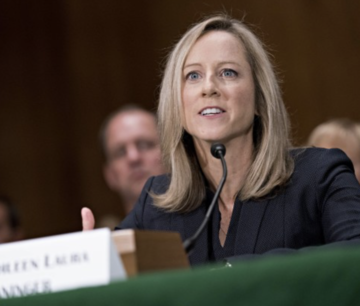
Kathy Kraninger
The Supreme Court is currently considering whether to accept an appeal filed against the Bureau by Seila Law involving an earlier U.S. Court of Appeals for the Ninth Circuit decision that found the single-director structure was constitutional. That court cited a 2018 decision by the U.S. Court of Appeals for the D.C. Circuit sitting en banc, which upheld the Bureau's constitutionality in another case brought by PHH Corp.
President is Not ‘Impeded’
Although PHH Corp. declined to appeal the D.C. Circuit's ruling, there continues to be other challenges: The Fifth Circuit Court of Appeals heard oral arguments in April for a challenge to the Bureau's constitutionality brought by defendants accused by the Bureau in 2016 of engaging in unfair payday lending conduct; in March, the CFPB defended its structure before the U.S. Court of Appeals for the Second Circuit, arguing that Supreme Court precedent reinforces its constitutionality, and also that its structure "does not impede the president's ability to perform his constitutional duties."
Earlier this year, the Supreme Court declined to hear a lawsuit challenging the Bureau's structure.
The Fifth Circuit recently ruled that the Federal Housing Finance Agency's (FHFA) structure, which is also single director, is unconstitutional. The FHFA had also decided not to defend its structure in that case.
Kraninger’s Statement
Meanwhile, CFPB Director Kathy Kranginer told Congressand CFPB employees that she backs the challenge to her authority. Numerous cases in the courts system argue that limits on a sitting president's ability to fire a CFPB director are unconstitutional.
Kraninger, who was appointed by Trump to succeed Acting CFPB Director Mick Mulvaney (who is also White House Chief of Staff and head of the OMB), sent House Majority Leader Mitch McConnell (R-KY) and House Minority Leader Nancy Pelosi (D-CA) in which she said the Bureau will join the Justice Department in supporting a Supreme Court review of a case pending before the 9th U.S. Circuit Court of Appeals.
“I have decided that the Bureau should adopt the Department of Justice’s view that the for-cause removal provision is unconstitutional,” Kraninger stated in the letter. “A Supreme Court decision holding that the for-cause removal provision is unconstitutional should not affect the Bureau’s ability to carry out its important mission.”
Should Kraninger’s opinion ultimately prevail, it creates an ironic situation in that should a Democrat win the 2020 election she could be replaced.