

NEW YORK–A new report by Accenture suggests that despite the expansive efforts by banks to support consumers and businesses during the COVID-19 pandemic, the level of customer trust in banks has remained flat, and that the best “answer” in moving forward and growing revenue lies in “purpose-driven banking.”

According to the report, which Accenture said underscores the need for banks to “reconsider their purpose,” further found most consumers and small businesses don’t trust their banks to be their financial advisors, with the common perception being banks are unable or insufficiently interested to promote their customers’ financial well-being.
“Trust is critical if banks are to capitalize on a promising opportunity for revenue growth: new digitally-enabled advisory services that help customers optimize their daily spend, rationalize their product portfolio and receive tailored advice,” Accenture said in releasing the report. “These could generate an average 9% retail revenue uplift for incumbent banks.”
Among report’s findings:
- 42% of consumers said the COVID-19 pandemic had negatively impacted their finances
- 55% of small businesses said their sales had decreased significantly or they had gone out of business
- Since the pandemic began, 16% of consumers say they trust their bank more to look after their financial well-being, but 15% trust their banks less
- Among consumers who are struggling financially, 11% trust their banks more, while 32% have lost trust
- Only 14% of consumers who have had a major life event with serious financial consequences in the past five years have turned to their bank for help
- 62% of retail customers said they would be eager to receive insights from their banks that would support their financial well-being
- Only 35% of small and mid-sized businesses seek advice about their business finances from their bank
- 70% of small and mid-sized businesses trust their bank to provide fast and reliable services, but only 51% trust their bank to look after their companies’ financial success
- Trust-based propositions, such as advisory services, can boost revenues of US retail banks by 9% on average
The survey research is based on responses from more than 5,500 customers and 1,300 small and mid-sized businesses in the U.S., U.K., Italy and Brazil.
Rediscovering Purpose
Accenture noted that in March 2020 it published its Purpose-Driven Banking Survey report in which it argued the case for banks to rediscover their original purpose: putting customers’ interests first and helping them manage their finances more effectively. Since then, the COVID-19 pandemic has swept the globe, it added.
“This is obviously a pivotal moment for banks. Many of their customers—especially consumers and small businesses—were struggling prior to the crisis,” Accenture said. “Today their situation looks even bleaker. The decisions and actions that banks take now and as the crisis plays out will have a big effect on customers’ prospects and will be remembered for years to come.”
Due to the effects of COVID-19, Accenture said it thought it would be worthwhile to revisit its original research. The second-wave study, in April 2020, surveyed more than 5,500 consumers and 1,300 small and mid-sized enterprises (SMEs). According to Accenture, it confirmed, firstly, that banks’ customers are in dire straits.
Among the findings:
· 42% of consumers said the crisis had negatively impacted their finances
· 55% of sole proprietors and small enterprises said their sales had decreased significantly or they had gone out of business
“Secondly, they’re not sure who to turn to for advice,” Accenture reported. “Our earlier survey found that of those consumers who experienced a major life event with serious financial consequences, only 14% turned to their bank for help. In our follow-up study, only 35% of small-business executives said they depend on their bank for financial advice.
Other Findings
- 14% of consumers experienced a financially impactful life event in the past five years and sought help from their bank
- 35% of small-business executives typically go to their bank for advice about their business finances
“Thirdly and crucially, low customer trust is impeding banks from offering the kind of advisory services that customers clearly need and that hold the potential of creating new revenue streams,” Accenture said. “While most consumers and SMEs alike trust their banks to protect their data and execute their transactions correctly, there is a significant gap between that and their level of trust that banks will look after their long-term financial well-being.”
According to Accenture, an in-depth analysis of the consequences of the trust deficit revealed 5% of retail banks’ revenue is at risk.
“This is the ‘bad revenue’ derived from services that have hidden or opaque fees, or that result directly from customers’ poor financial habits and decisions,” said Accenture. “It is also the revenue that is being targeted by innovative new competitors and by regulators.”
Lost Revenue
The report further argues low trust also makes it difficult for banks to capitalize on the potential 9% increase in revenue that it calculated the average retail bank could achieve by offering innovative digitally enabled advisory services.
“The COVID-19 crisis is the ideal time for banks to show customers what they can do for them on their best day. Many have done great work under difficult circumstances,” Accenture said. “But as our survey shows, while trust levels have both risen and fallen among different groups of customers, the net result is banks have not succeeded in moving the dial in their favor.”
Accenture reminded banks should also consider their future. The report asks: Will they revert to business as usual or redefine their role, helping customers become more proficient at managing their finances? What new capabilities and attributes will they need? Where will growth come from?
“We believe purpose-driven banking holds many of the answers. An authentic win-win model requires a strategic plan based on the realities of the current crisis and on a vision of the bank's future role,” Accenture stated.
The Opportunity
According to Accenture, the rationale for purpose-driven banking was compelling prior to COVID-19.
“The subsequent crisis has not only validated the key premise of our earlier report; it has also magnified the need for the changes we recommended and compressed the timeframe in which banks need to execute them,” the company said in its analysis. “To adopt an authentic win-win model that puts customers’ interests first, builds trust and unlocks the potential for new revenue streams, banks need a strategic plan based on the realities of the current crisis and on a vision of their future role.”
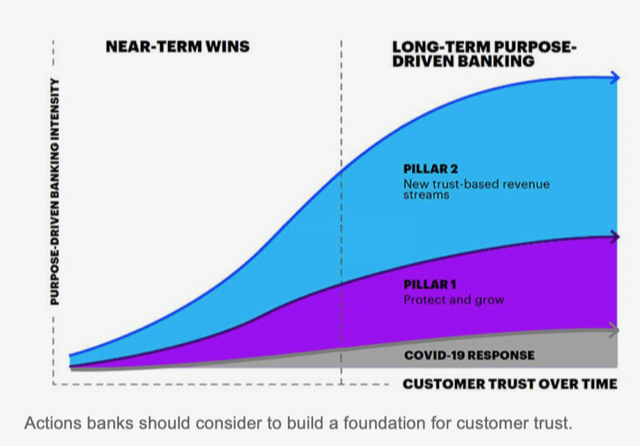
Accenture said it believes a set of actions are needed that fall under two key pillars:
Pillar 1: Protect and grow market share. “This comprises immediate steps to improve operational efficiency, increase transparency and help customers improve their finances.”
Pillar 2: Create new trust-based revenue streams. “At the same time as implementing Pillar 1, banks should start to plan the riskier but higher-return Pillar 2 initiatives: developing innovative ways to expand the scope of advice to meet customers’ needs.”
“Together, these two programs offer a promising path to recapturing customer intimacy and trust that will endure,” Accenture said.