

BOSTON–There are a number of “hidden risks” being disguised by the robust credit union auto lending boom of the past half-decade, according to one person.
The most troubling issue: Loan walletshare among members who consider their credit union to be their primary financial institution have actually declined.
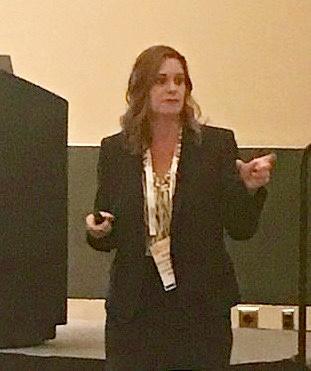
Susan Hochsprung
What it adds up to, said Susan Hochsprung, VP-Sales with CUNA Mutual, is that credit unions should be “a little less comfortable about what your balance sheet is telling you today.”
As CUToday.info has reported and as Hochsprung noted, year-over-year growth in auto sales has led to record auto lending at credit unions, although that growth has started to slow (there are about $1.1 trillion in total auto loans in CUs after a 15% annual growth rate over the past three years).
Most of that growth is driven by indirect lending, with just 10% of those in attendance at a session at America’s Credit Union Conference saying their CUs do absolutely no indirect loans.
“The little bit of a concern is the direct auto lending looks like it will slow in the next few years,” said Hochsprung.
So, where is the bad news in all of these numbers? Hochsprung pointed to some direct consumer research CUNA Mutual launched in late 2017 that explored share of wallet. One of the findings was that credit unions have increased their overall share of wallet with members since Q4 2015, even as CUs grew their total number of auto loans by 22%. That’s the good news.
Digging Deeper
But more troubling data can be seen in digging deeper, said Hochsprung.
CUs over that same time grew their number of PFI member loans by 7%, while CUs grew their number of non-PFI member loans by 44% (a reflection of indirect loans). But the actual share of wallet among PFI members has decreased by three percentage points over that time.
“Who is being picked away from credit unions?” asked Hochsprung. It’s the PFI members. “We were surprised by this, and we are concerned. Obviously, our PFI members are the ones most loyal to us. We hear over and over that members are loyal to us, but we live in an Amazon world. Convenience will always trump loyalty.”
Hochsprung cited Filene research finding that 88% of CU PFI members said they intend to give their CU most or all of their future business. But, “if they are being eroded away from us, what happens in the next economic downturn.”
Why is share of wallet among PFI members lagging behind non-PFI growth? Hochsprung pointed to research done by Javelin on the “silent churn principle,” which holds that while many PFI members maintain existing accounts, they’re purchasing additional banking products elsewhere.
In many cases this is due to fintechs picking away at the most profitable products among the most profitable members and consumers, Hochsprung said.
“The thing that really scares me is look who is up three percentage points in wallet share among PFI consumers? The banks,” said Hochsprung.
The Decision Driver
When examining the reasons consumers were choosing banks as well as looking into risk-drivers, Hochsprung said the research showed that credit unions lead on fees and rate. But it wasn’t a consumer preference that had created the troubling scenario in auto lending for CUs. Instead, the research found consumers were using a bank because it was the provider was associated with the car dealership or recommended by the dealership.
Another troubling trend, said Hochsprung, is that many CU execs incorrectly believe they send the most offers to their own members for auto loans, creating a false sense of security, but the reality is credit unions are being out-marketed by a three-to-one ratio by non-CU auto lenders.
“The scarier news is that’s just the auto loan category. If you look at the categories where fintechs have had some success, such as student loans, that ratio goes to five-to-one,” said Hochsprung.
What Can Be Done to Counter the Risks?
Hochsprung said there are four keys to greater share of wallet
- Measure and track share of wallet
- Optimize the member experience
- Defends share of wallet
- Grow the share of wallet
Measuring & Track Share of Wallet
With few in the room indicating they track share of wallet, Hochsprung said it’s hard to gather and track the data, beginning with understanding the member’s full financial picture. The way to get at calculating share of wallet, according to Hochsprung, is to do a member survey (which can be time consuming and costly), or work with a third party provider to gather and append the data to create reports.
Optimize the Member Experience
To optimize the member experience, a credit union must eliminate the pain points, including digital channels not being fully integrated into the process, fear of getting a bad deal on financing, lack of guidance, expertise and control, concern over process taking too long, and lack of personalization.
Every credit union needs to do a “journey map” and make the process as seamless and painless as possible by removing those friction points, said Hochsprung. “The more digitally engaged the member is with you, the more likely they are to be loyal and to hold more products.”
Defend Your Share of Wallet
Engage your new members right away, encouraged Hochsprung. “We have found over and over in research this is critical,” she said. “Make sure they understand your message and value proposition.”
Other steps to take:
- Utilize predictive analytics to ID at-risk members
- Monitor members’ hard credit inquiries.
- Target members with relevant offers and communications
Grow Your Share of Wallet
Growing share of wallet begins with optimizing direct marketing, said Hochsprung. She noted communications with 25% open rates featured lower rates, relevant offers or a better experience in the email subject lines.
“Members demand more relevant offers,” said Hochsprung. “Triggers or signals can help you tailor loan offerings to a member’s needs.”
Hochsprung said those triggers can include a member’s rising income or improving credit score, a mortgage rate increase, or a debt payoff.
A Big A-Ha
A “big a-ha” in the research, said Hochsprung, was how credit unions out-perform banks in auto loan recapture efforts. “Every credit union should be doing this,” said Hochsprung.
She also urged CUs to use bill pay and credit bureau data in predictive models to ID refinance candidates, to focus messaging on monthly payments, not rates; to use multiple channels to reach prequalified members and provide several easy response options, and to offer incentives to encourage actual applications.
“Credit unions control 42% of all outstanding auto loan dollars,” said Hochsprung. “And that means 58% is outside credit unions, and that is a crying shame. We should own this. We have $422 billion in outstanding loans with other lenders that are an opportunity to go after.”