

BOSTON–Much of the legwork for serving a $380-billion market opportunity has already been done by numerous companies—companies that need credit unions as partners as much as CUs need them, according to one person.
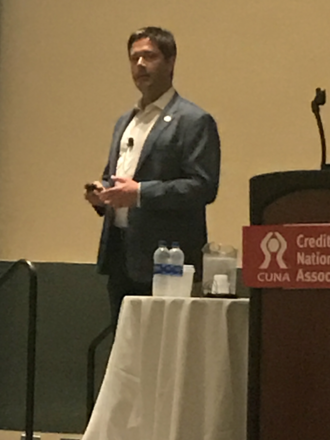
David Dean
David Dean, senior VP with CU Solutions Group, a unit of the Michigan Credit Union League, told America’s Credit Union Conference here that $380-billion opportunity can be found in unbanked and underbanked consumers. But before his audience tuned him out at mention of the words “unbanked” and “underbanked,” Dean stressed there is a reason so many companies—start-ups and major brands alike–are chasing the market.
Dean acknowledged stories of the unbanked often inspire empathy, but instead he focused on the “business opportunity” in the market.
“One thing (CUSG has) discovered…is many of them had intentionally left the system,” said Dean. “They had dumped us, we didn’t dump them.”
He cited data showing 28% of the U.S. population, or 88 million people are either unbanked (no checking or savings account) or underbanked (have a limited relationship with an insured FI).
“These people are not statistics,” said Dean. “They aren’t homeless. They are your Uber driver or the guy who gave you coffee this morning, or someone who may not be a bad decision-maker but maybe had something unfortunate happen to them.”
So, how is it even possible that all of these people feel they cannot afford to bank? asked Dean. The “dilemma is obvious, he answered. Credit unions desire to help this population, but “at the end of the day we are a business and need to keep the lights on.”
Middle Point
Where a middle point might be found, he suggested, has emerged in the last six months. “An opportunity has surfaced,” according to Dean, who said credit unions need to act quickly.
That opportunity? Financial technology, or fintechs, he told ACUC, quickly acknowledging that many people have started to tune-out messages around fintechs as they’ve heard it so often, even though they know they need to do something.
“We really are at a tipping point,” Dean said. “And it’s happening in the unbanked and underbanked market.”
Dean, who was a TV producer for 13 years, said the concept of “cord cutters,” that is, cancelling cable TV service, is similar to what is happening in the underbanked market.
Dean noted that in recent months Amazon, Green Dot, Walmart, Apple and Uber have all begun reaching out to the unbanked with financial and payments services, and doing so “under the radar.”
“What PayPal is doing is pretty intrusive,” he said. “They have had PayPal Cash, but within last few months they have introduced banking services around it. They have the whole gamut.”
Each of those companies has partnered with a fintech, said Dean, before emphasizing that many are seeking to partner with financial institutions, including credit unions, after discovering just what’s involved with compliance and running a financial institution.
“I think the underbanked would want to bank with us, but we have to give them the technology to do it,” said Dean. “And we have to partner with the fintechs to do it.”
Starting The Conversation
CUSG has been talking to companies ranging from PayPal to small startup fintechs, according to Dean, who said the company seeks to get conversations started around the idea of the scale the entire credit union community represents.
Among the fintechs CUSG has been talking to, according to Dean:
- Acorns (which can be accessed directly or through the PayPal wallet). Acorns uses credit/debit card to round up change from purchases and then uses those funds to create an investment portfolio.
- Stash. Similar to Acorns in offering micro-investing, Dean said Stash allows the unbanked (along with anyone else) to “join the investing game.” Stash recently announced it is starting a full portfolio products by partnering with a small bank. “We’re saying we want to use your technology and then brand it as our own and replicate it for credit unions.”
- Digit. Digit is an automatic checking/savings mobile app that connects to the user’s checking account. “People love this app. It is blowing up,” said Dean. The service does have a $3 a month fee, however. “We could certainly offer a competitive product without the $3 a month and draw a lot of business,” said Dean.
- SmartyPig. The app also offers a keep-the-change solution and provides updates on savings goals.
- Winwin. Winwin is a brand new personal finance app that gives users an interest-bearing, FDIC-insured savings account that “gamifies” financial progress. Its stated mission is to help the 140 million Americans who don’t have enough money saved. Each dollar a user saves doubles as a “lottery ticket” and a chance to win a $1,000 prize. Similar to the Save-to-Win initiative within credit unions, Winwin offers an online app that is lacking (for now) in Save-to-Win, said Dean.
- Other fintechs he said could be partners include LearnLux, Wealth Factor, eCreditHero, FigLoans, InterWallet, DocuVital, Finova Financial, Gradvisor, Upsie, Painless1099 (which automates taxes for people working in the gig economy).
“If you look at their websites, all of their branding is about the unbanked and the underbanked,” said Dean. “This is what I mean by arriving at a tipping point.”
He noted that many of the fintechs are targeting micro-niches, such as underbanked women of color.
Dean acknowledged that these markets have very low margins, which is why scaling up offerings is so critical.