


Steve Rice
SEATTLE–Credit unions here were offered some education when it comes to financial education—and in an appropriate, easily digestible form.
Steve Rice of Everfi stressed that one significant change that has occurred as cellphones and smart devices have become omnipresent is the key concept of “know before you go: People like to understand things before they act on them.”
Case in point, shared Rice in remarks at CUNA’s America’s Credit Union Conference here: In 2006, 35% of people surveyed said they would like to know more about financial education. By 2013, that figure had risen to 65%.
“People now are really changing their attitudes about wanting to know things before they act on them,” said Rice. “That means two-out-of-three people have an unmet financial education need. That is really compelling.”
But just because it’s compelling doesn’t mean it’s engaging, according to Rice, who said 68% of people have said financial planning materials are “boring.”
“An informed member is your best member,” Rice told the meeting. “Consumers are 29 times more likely to buy through an online educational experience than media advertising.”
Rice, who was a teacher at one point in his career, said the thesis is that education equals trust. “AND if education equals trust and trust equals loyalty, then education equals loyalty.”
To build trust and loyalty in financial education, Rice offered these best practices:
- Make it Short. Period. “With adults, you have to keep it really, really short. I have seen bank and credit union websites with really long PDFs there. If you’re doing financial education with lots of text and lots of PDFs, that is not effective. People need to be able to consume these things in a minute or less. I suggest each topic be just a few minutes long.”
- Make it Just-In-Time. “It’s important to show that whole selection of everything that people can learn about, but it can be a little intimidating. Marketers know about the ‘paradox of choice’; if people have too many choices, they freeze. The sweet spot is six to eight. If you narrow it down, make it just in time and relevant, that’s really important.”
- Make it mobile. “If I go to a website and it’s not mobile-enabled, I don’t even bother anymore. We see about a third of our users on our platform are mobile, and a few years from now it will be two-thirds.”
- Make it unbiased and relatable. “You don’t want to be pushing product. People can see when you are doing that. You don’t just want to talk about the good parts; you also want to talk about fees and how fees work. Millennials, especially, are skeptical.”
Rice said he believes credit unions have a “huge opportunity” to connect with the next generation. To leverage that opportunity, he advised:
- Relationships are key. Loyalty to brands like Apple and Facebook and Starbucks is very, very high.
- Millennials are “cynical do-gooders. There is an inherent skepticism, but also a desire to make the world a better place.”
- Millennials actually save more than Gen Xers and Boomers.
- There is support for local businesses.
“Anyone out there that doesn’t have a Millennial focused strategy is missing out,” said Rice.
Other points made:
- Interactivity increases earning and retention. “Try to recreate that digitally.”
- Quizzes, surveys and polls provide valuable data. “Throw a quiz in every once in a while during your digital education. We have 100% response rates on our surveys because people are already interacting.”
- Always tie in a relevant action. “Financial education is important, but if it doesn’t result in a behavior change, it’s a waste of time. People are hesitant about financial topics, because they feel like they ought to know this. That’s why I highly recommend at the end of your financial education that you include a call to action of some kind.”
Why should a credit union collect data around financial education? According to Rice, the value lies in:
- Understanding financial health of members. “You need a way to be able to measure that for your members, and you can figure out ways to help them improve their financial health. Some of the most financially unhealthy people out there have high salaries or high balances.”
- Polls measure attitudes and behaviors. “It’s a great way for people to engage. People don’t like to take polls, so you have to make it interesting and intriguing.”
- Measure action taken after educational interventions. “You have to measure behavior change.”
- Financial education can be part of an alternative FICO score. “There are 26 million people who are credit invisible,” said Rice. “To engage with them, financial education can be part of the alternative FICO score. Just a willingness to engage with financial education is probably lower risk than someone who ignores it. You can use your financial education data to really understand your member better.”
- Great value-add for SEG relationships. “If you can provide not just great financial products, but also provide a financial snapshot of members, this is very important to employers.”
Two credit unions that Rice said do a very good job with financial education are:
- Suncoast CU in Florida, with its “mPower” program. “mPower is targeted, human-centric, interactive and data driven. The information is all grouped and easy to digest. Human-centric means it’s not all about the credit union, but about the member.”
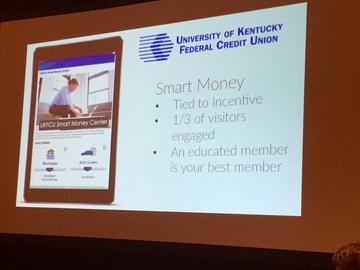
- University of Kentucky FCU with its Smart Money program. UKFCU even offers an incentive in the form of loan rate discounts to those who take financial education courses.
“Any credit union that does not have a robust, interactive and mobile friendly financial education program is doomed to fail,” said Rice.