

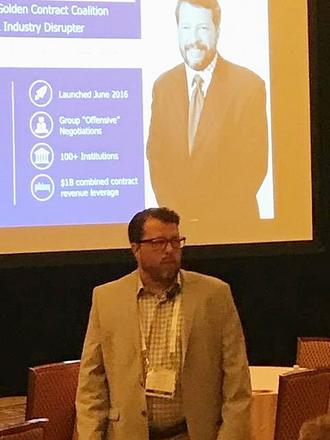
Aaron Silva
LAS VEGAS–Are you prepared to risk millions of the credit union’s dollar on a guess?
Many CUs are doing just that with their data processing contracts, according to one company that has spent considerable time reviewing and negotiating vendor agreements.
Aaron Silva, CEO of Paladin fs and the Golden Contract Coalition, told credit unions that much of what he sees in the data processing contracts credit unions have signed is “disturbing” and “upsetting.”
Speaking to CUNA’s America’s Credit Union Conference here, Silva offered 10 different ways CUs are often out-negotiated at great cost to themselves and their members, including offering real-world examples of difficult and expensive scenarios credit unions have faced.
Paladin fs is a company that specializes in negotiating contracts on behalf of credit unions and is paid on a contingency basis. The Golden Contract Coalition was formed to bring together smaller institutions to leverage the power of large group negotiation. It is designed for institutions with two- to 10-year terms remaining on contracts and seeks to deliver both individual cost reductions and customized terms. It has partnered with the Pillsbury law firm, which specializes in contract negotiations.
In his 10-point countdown, Silva covered the disadvantages credit unions are facing as soon as they sign contracts with many vendors, the ongoing implications and costs, and what can be done—if anything.
10. Ten Core Providers
Data processing technology as a part of non-interest expense is increasing faster than non-interest expense.
“To put this another way, IT expense is gobbling up more and more of your budget every year,” said Silva. “Why? Shouldn’t technology expenses be going down? What’s going on? The number 10. When I started in the early 1990s, there were 50 vendors offering core services. Today there are 10.”
Silva described the current market situation as an “oligopoly” in which three companies control 90% of the data processing market for institutions of more than $1 billion in assets, and 85% of the market for those under $1 billion. “It makes it very different to negotiate against these folks. All of you should have something in your agreement called ‘Change of Control’ that if they are acquired you have certain rights.”
9. Service Level Agreements (SLAs)
“What I’ve earned is they are not SLAs, they are SLOs: Service Level Objectives. If (your system) fails, there is supposed to be a credit on the invoice and, further, it should say if you continue to fail in the same way, the credit increases until the point the credit union has the right to leave the relationship with no termination expense. But SLOs basically say ‘If I’m doing a bad job and something fails, call me, and I’ll do my best to fix it.’ And this may go on for weeks or months or years, and when all is said and done, you have right to negotiate with them. And this is something that has to change.”
As an example, Silva said one credit union’s provider sent out 20,000 statements to the wrong members. It was a huge GLBA violation. “This credit union spent countless hours apologizing,” noted Silva. “The supplier admitted ‘We screwed up.’ In the SLA, the penalty was 19 cents. Eventually, that was made $5,000, but still not even close to the cost.”
8. They Know That You Don’t Know What You Don’t Know
Lack of knowledge, said Silva, means vendors have “a distinct advantage over you.”
Silva said credit unions may compare pricing with other CUs in their area, but said what CUs really need is a national perspective.
As an example, he pointed to one supplier that quoted $100,000 as a set-up fee for three new products. The vendor said it would cut the price if the credit union extended its price by three years. But unbeknownst to that credit union, they were already paying six times market value, or overpaying $17,000 a month. The extension cost $625,000. The same three products were being installed across the country for a set-up fee of less than $10,000.
“This is a sensational example but, trust me, this happens all the time,” said Silva. “It costs suppliers less over time to do business with you, while their pricing is going up. OK, fine, that’s capitalism. But you have to be smarter than that and before you do big product purchases, you should make sure you are getting it right.”
7. Clawbacks
“This is something we’ve noted in last three four years that has come into vogue,” said Silva. The clawbacks are in most post-2012 agreements that include discounts.
Example: a $700-million CU acquired in a merger planned to terminate its agreement three months early and planned to pay a kill fee estimated at $120,000. The vendor came back and said the termination fee is actually $1.1 million. Why? The agreement signed nine years earlier included an amortized credit, and even though it had been all used, it stated that if CU went through merger it all had to be paid back. The credit union opted to let contract run out to the end.
6. Punished for Helping Your Core IT Supplier GAIN Market Share
“This is exactly what the core providers due to you if you ever merge,” said Silva, referring to instances in which the two CUs are running on competing platforms.
As an example, he cited a credit union merger in which the acquired CU had to pay $860,000 fee to terminate and de-convert, and then the acquiring CU had to pay a fee for conversion, even though the merger benefitted the acquiring CU’s data processor. “The supplier is unfairly rewarded. They had no customer acquisition cost,” said Silva. “They should be splitting this with you, and they will, if you know what to ask for. But this is exactly the way your agreements are written right now.”
5. Punished for Helping Core IT Provider MAINTAIN Market Share
In this case, it involves two CUs running on the same data processing platform. One CU ends up covering all the costs related to merging the two systems.
“This idea they will do conversions at prevailing rates–no way,” said Silva. “Before you do a conversion you should absolutely write a scope of work that says you will complete this work in this amount of time, or there will be a penalty.”
The vendor may give an option to extend an agreement by a term equal to the value of lost profit. “How is it possible that servicing two institutions on the same platform is more expensive for that provider?” asked Silva. “Their costs are lower, and you pay more, and that is absurd. A lot of mergers are taking place, so you need to watch out.”
4. Inefficient National Pricing
Disparate prices are all over the place for the same exact services, according to Silva. “A core is a core is a core. There is nothing that a vendor does anything different in the backoffice than another vendor. What really matters is your digital services, what faces the members.”
Silva said his company has found eight of 10 contracts are priced 13.15% to 43.1% above fair market value. Silva stressed that the percentages need to take into account that certain services have commoditized and are relatively uniform in pricing.
“The average impact of 108 deals we’ve done is $1.2 million per institution or more,” said Silva.
3. Industry Needs a New Deal
Most contracts in place have been using same language since 1985, said Silva. A gap analysis shows core IT contracts are sub-standard, outmoded, outdated, risky, one-sided and legally non-conforming, he said.
Where big corrections are needed is in four areas:
- Anything related to mergers, acquisitions and other corporate events. (The audience indicated they all felt they were charged every time they contacted their vendor, even for routine things.)
- The termination rights of the parties. “A lot of contracts say you don’t have to use the vendor’s services, you are just prohibited from using anyone else’s.”
- Real services levels
- Governance structure
“A paradigm shift in the contracting process is needed,” Silva said.
2. Timing is Everything
The best time to begin negotiating is when you have 24-36 months remaining on an agreement, according to Silva. “You want to conclude between 24 and 18 months of the contract’s end; that’s the sweet spot. Why? Because if the deal falls apart, you can switch. If you start negotiating at less than 18 months, your leverage drops off significantly. The vendors are trained to come talk to you when you have 12 months left, because you are not going anywhere. So, timing is everything. Your vendors are incented to come back and sell you additional services after you close the main deal, because with new services you add to the contract. They should all terminate at the same time.”
1. Trust But Verify.
Silva referred to most vendors as “professional poker players. They know how to make you feel like their buddies.”
Silva said no credit union should ever sign a three-year contract. “As you do that you are signaling to them you are not a long-term player and any benefits you might have gotten, they will be taken off the table,” he said. “Trust but verify. There is no such thing as a 10-year deal. Why would you sign a 10-year technology contract? If you’re in-house, that’s different. But I’m talking outsourcing. The longest contract you should ever sign is seven years, and for seven years it better be awesome. Your vendor will never volunteer something that benefits you more than them. Never go into a deal before knowing what’s in your hand.”
Those credit unions that say they already have their attorney or in-house general counsel review a contract are not being protected, according to Silva. “They do not have the data or experience to know what is possible,” he said.
Silva described Paladin fs as a research firm ahead of being a consulting company. It conducts an assessment for CUs that have less than 30 months remaining on a contact, and makes comparisons to its “Blue Book” for pricing. That process takes about three weeks, he said.
“We will tell you what you should be paying, where your contract looks strong and weak,” he said. “We will share with you all the information we can.”
PaldinFS.com is paid on a contingency basis, and typically is paid between 25%-30% of savings on the contract.