

WASHINGTON—Leadership transition, policy reform, and grassroots momentum defined the opening day of America’s Credit Unions’ 2025 Congressional Caucus, where current CEO Jim Nussle and incoming CEO Scott Simpson shared the stage to chart the future of the movement in a fireside chat.
In addition to Nussle and Simpson’s discussion, meeting highlights included America’s Credit Unions advocates discussing grassroots movement-building and takeaways from the “Don’t Tax My Credit Union” campaign.
During the fireside chat, Simpson shared his thoughts about what’s ahead for the credit union industry and how credit unions transcend political ideology.
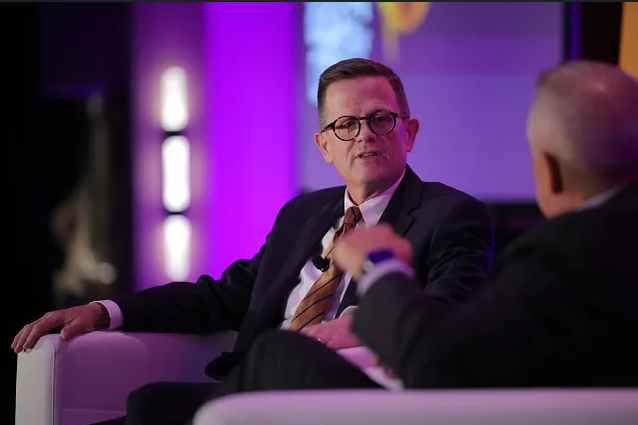
Scott Simpson (L) speaks with Jim Nussle at Caucus.
“What’s great about credit unions is that it transcends political ideology. It genuinely does. Not every issue can do that, but the social mission, the heart is fantastic, but there's this kind of private sector business solution that you can deliver,” Simpson said. “I think one of the challenges we have as a national association, as a movement nationally, is we have to make sure that we're always in position to endure wherever that ideological pendulum swings.”
When asked about how he’ll lead national efforts to protect, empower, and advance the credit union movement, Scott said, “We cannot afford to be anything but world-class advocacy professionals, linked arms, shoulder to shoulder, because we are wildly out-resourced. The primary responsibility for us is to convene, to listen, and then go out and find a solution. Then we use our megaphone to scream that solution in state capitals, and Washington, D.C, America’s Credit Unions and the state leagues are doing great work, and my responsibility is to ensure leagues hear and see and are empowered to take advantage of their opportunities.”
Discussing the importance of continuing work to amplify the life-changing differences credit unions make, especially in the face of banker and credit union opponents attacks, Simpson said, “The work [credit unions] do every day changes the lives of people, and you know that. We have to lean into that story, telling the humanity of what we do, because it’s absolutely true, as I’ve seen in my own life, and it transforms lives.”
Simpson described how America’s Credit Unions, advocates, and members have to amplify stories and support policies that support the communities they serve.
“We need to have a full understanding of how to unleash the 144 million American credit union members. It’s their undeniable will that they have access to cooperative finance in this country,” he said. “They've made the choice. They don't want that taken away.”
Active, Constant Advocacy
A breakout session on the importance of grassroots advocacy explained why such programs are necessary at credit unions of all sizes to achieve advocacy goals. A general session shared successful tactics during this year’s Don’t Tax My Credit Union campaign.
“You don't start a culture of advocacy when you're getting ready to go to war. You do it well ahead in time in starting to plant those seeds, and it’s very important to start from the top down. Get your board members involved, your team involved, and you explain to them the importance of advocacy,” said Amy Brodersen, president/CEO of Family Focus Federal Credit Union. “The ‘why’ behind it is really important. In today's world, we forget to explain to people why they're doing things, and to get buy-in, you have to be able to tell them why. My team in particular gets it, because we talk about it. It's in our culture, it's in our staff, in our shop all the time.”
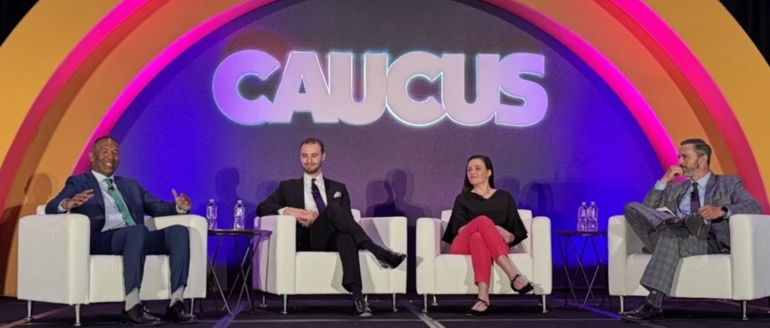
As a small credit union with 12 total staff members, Brodersen said tools like America’s Credit Unions Member Activation Program and Project Zip Code are key to maximizing impact for credit unions of any size.
Brent Tercero, executive director of credit union advocacy at SchoolsFirst Federal Credit Union, said his credit union works to have a member of each team on the advocacy committee to make sure information gets to staff in all areas.
“If you're just starting off in the grassroots world, finding small wins to demonstrate to your team the importance and power of grassroots, advocacy, and grassroots organizing - that's what gets people excited,” he said. “In organizing, there's this saying, ‘how do you eat an elephant? One bite at a time.’”
He shared the credit union’s success in setting up an event to shore up support for the credit union tax status with House Financial Services Committee member Rep. Young Kimn(R-CA). More than 100 credit union members attended, and at least two-thirds were constituents from Kim’s district.
April Mobley, Texas Grassroots and PAC director for the Cornerstone League, encouraged credit unions to work to make sure members know what’s at stake.
“From the Don’t Tax campaign, to the next state legislative session, every voice matters. Whether it’s an action alert response, whether it’s a phone call to that elected official's office, whether it's a comment call for a regulatory issue, every voice matters,” she said.
Cornerstone’s approach included more than 100 meetings with Congress, including multiple fly-ins from each of their five member states to Washington, during the Don’t Tax My Credit Union campaign, ACU said.
While recapping the campaign, Utah’s Credit Unions President and Chief Advocacy Officer Rusty Cannon shared how they made an impact. Utah credit union members sent more than 98,000 messages to members of Congress through the campaign, the second-highest amount by state.
“Any time we can get good facts in front of our elected officials is very much appreciated,” he said. “We start from very early on in the relationship with all of our elected officials, getting them the types of stories, the types of numbers, because they make an impact in an important way.”