

SAINT PETE BEACH, Fla.–Four board members, all of them chairs or former chairs, offered their views on everything from why they got involved, what they think are most important challenges facing boards, succession planning and more.
Speaking as part of a panel discussion during the African American Credit Union Coalition annual conference were Sandra DeVoe Bland, board chair with SRP FCU; Isaac Dickson, board chair with Carolina Foothills FCU; Dr. Michelle Nearon, former board chair with Bethpage FCU; and Janice Smith, board chair with Kansas City CU.
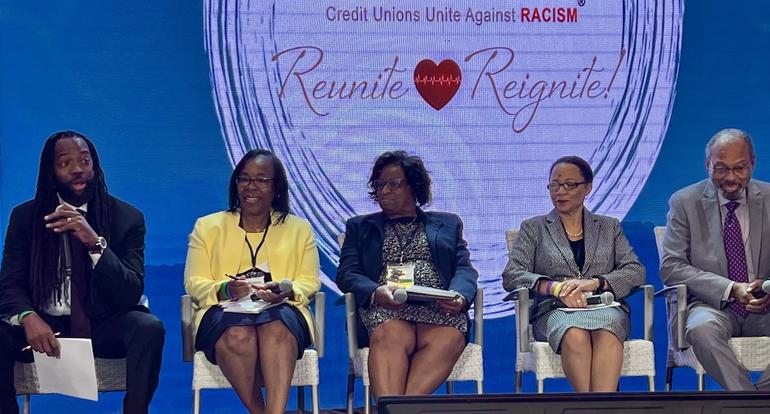
From left, Gregory Jenkins, board chair with Greensboro Municipal FCU; Sandra DeVoe Bland, board chair with SRP FCU; Isaac Dickson, board chair with Carolina Foothills FCU; Dr. Michelle Nearon, former board chair with Bethpage FCU; Janice Smith, board chair with Kansas City CU.
The discussion was moderated by Gregory Jenkins, board chair with Greensboro Municipal FCU. Here's a look at what was discussed.
Jenkins: Why did you join the board?
Bland: Because another board member told me to! In all reality, I really wanted to represent an underserved portion of our communities. We serve 10 counties, and one of the underserved counties is my home county.
Smith: We were the credit union’s second SEG, and I did not feel the credit union was serving my employees in the same way it was serving the city of Kansas City employees. The credit union was in city hall and our hospital was miles away, with employees working different shifts. It was difficult for them to get to the credit union. I wanted to find ways for the credit union to come to our workplace. They started visiting every other Friday. I realized I needed that to be a voice and have influence, I needed to be on the board.
Nearon: The primary reason I wanted to join the board was to find a way to give back to my community. But I was also trying to find a way to grow professionally. I knew when I interviewed for a board position they were looking for ways to diversify. I have been in academia for most of my life after designing aircraft and automobiles for 10 years.
Dickson: I joined the board I have always had a passion for community service. The board became another venue to serve the community. I threw my hat in the ring and fortunately I was elected.
Jenkins: The pandemic has hit everyone differently. How would you say your credit union adapted to the pandemic?
Smith: One thing I’m proud of is we did not close for one day. Like everyone else, we reduced the number who could enter the facility—two in the lobby and two could meet with employees. The board went to Zoom meetings, which we had done rarely. That was challenging at first as we had connectivity problems. But we also set up a plan where management staff paired together. One would work from home one would work in the office, so if Covid did hit we always had coverage. We probably ended up with four cases in the two years.
We realized there were services we could provide through the drive-through that we had not provided before, and we are still doing that today. We realized there were services we were providing in-house only that could be done in other ways. Our main branch moved the loan application process to another branch. We initiated online loan applications. Our credit union was started in 1990 but no one knew who the Kansas City Credit Union was, so we started rebranding and they know who we are now.
Nearon: There are three models of governance, fiduciary and strategic and generative. Generative means being more reflective and taking an outward look and thinking about things that might happen. For our credit union, we paid more attention to the generative model and started asking, because of the pandemic, how can we make quicker adjustments? This is not going to be the last thing that hits us by surprise. Now, it’s what should we be thinking about and thinking long-term? We have a crisis management team and have been ramping up drills. I think it’s important to take the lessons learned from this pandemic and take a more reflective approach.
Jenkins: How has your board tried to add the 8th Cooperative Principle?
Dickson: We realized years ago our membership was diverse, but our staffing and board was not. When I was elected in 1991 I was the youngest on the board and the only minority. We were very intentional as we recruited board members and replaced staff that we had more people who reflected our membership. We needed more females in place, more Blacks, and more Hispanics. I am now the oldest person on the board, and we have Hispanic representation, female representation. We look more like who we serve. Our leadership team looks more like our members. We have been very purposeful about that. The response from membership has been very positive, as well.
Jenkins: One report said the five biggest challenges facing credit unions are data breaches, keeping up with regulations, exceeding customer expectations, surpassing the competition, and incorporating AI. Do you agree?
Bland: I agree with four out of five; surpassing the competition I disagree with. As a credit union we believe in co-opetition, big credit unions helping smaller credit unions. When we have acquired smaller credit unions it was because they asked to become part of the SRP family. There was a chance for a bank to become part of SRP, but it just wasn’t right, so we said no. It’s not just people helping people, its credit unions helping credit unions.
Nearon: I would add something to the list. To remain relevant, I think you are going to have to focus on DEI initiatives. I think it is imperative for conversations to continue to address the underserved populations to remain relevant in your communities.
Jenkins: Given the fast-paced nature of credit union movement, how important is board education?
Smith: I don’t know how a credit union survives without board education. We finally put money in our budget for board education. If a board is not knowledgeable they cannot serve the credit union. They are not familiar with the financial needs of the organization. It's imperative. Training and development of the board is just as important as training and development of staff.
Nearon: It’s essential. The research shows that boards that invest in education are at organizations that are more successful. They tend to be more productive. What they say is respected and trusted by their peers. It helps build consensus when there are issues.
Bland: Not only is education important, but development and training. Learning is fun for our board. We have evolved. We are constantly learning. And because we are in a state of constantly learning, our staff is constantly learning. The engagement and the excitement is so phenomenal. It makes you want to step up to the plate. Be educated before you execute. We make sure before we adopt anything new or modify an existing concept that there is a thorough understanding.
Jenkins: What about succession planning?
Bland: It’s extremely important. The least experienced person on our board has 20 years’ experience. We have an ad hoc advisory committee where we look for skill sets, diversity, what do they bring to the table, and making sure that all the ingredients are there to allow SRP to remain an effective community servant. We have an 11-member board who are active and who show up either in person or virtually.
Dickson: We have a seven-member board but 100% participation most months. Succession planning in the past for us has not been an organized, structured plan. We are in the process of rethinking our process of having people who join the supervisory committee and then the board. We are looking for ways to further engage our membership so they are involved and more of those people will offer more choices.
Nearon: One of the reasons I’m a former board chair is I firmly believe in term limits. I served five three-year term limits. At Bethpage, we had associate board members who were board members in training. They served one-year terms and also served on committees. Then when board seats opened up we had a pool of associate board members to choose from. And one of those associate directors stepped up in my place.
Jenkins: What about contraction in credit unions?
Dickson: I think it’s inevitable. We would do well not to fight it and make the best of it. Smaller credit unions cannot afford to provide all the services. It’s a great opportunity for us to work with some of those smaller credit unions that can survive, and those that cannot, we can merge in.
Nearon: I would just ask and hope that the smaller credit unions that might be going under for various reasons, that instead of doing the easy thing and absorbing or getting rid of them, that we look at why they were established to begin with and are they meeting their mission. Is there some way to maybe help them and pull them up?
Smith: I’m proud to say in Kansas City that a new credit union is being opened to serve a minority credit union.
Bland: I do believe credit unions will survive. You have to keep going and walk your purpose and make small steps. SRP FCU grew organically like weeds and we are still growing ($1.8 billion). We will reach out and mentor you; we’re not here to take you over. We will partner with you. If we are hosting an education session at SRP, we will include you. Our staff will share information. We are here to help.