

ST. PETE BEACH, Fla.–During a session that was modeled on the lessons and experiences of an improv class, credit union leaders were offered lessons, examples and the opportunity to act out ways to “Lean into Discomfort with Courage.”
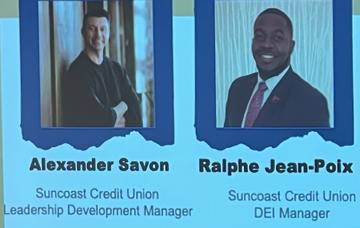
During the African American Credit Union Coalition annual conference here, Alexander Savon, leadership development manager, and Ralphe Jean-Poix, DEI manager, both with Suncoast Credit Union in Tampa, used a strategy more often associated with comedy shows and public performances to encourage CU leaders to tackle issues within their own institutions.
“When we lean into discomfort we are able to open up our perspectives and we are open to new ideas,” said Jean-Poix. “Naturally, we don’t like to lean in. We don’t like discomfort. It makes us nervous. But on the other side there is a lot growth.”
Savon noted that when he joined Suncoast Credit Union in 2014 he also began taking improv classes as a way to get out of his comfort zone. It even led to an improv program within Suncoast itself for employees.
“Improv helps with change management,” said Jean-Poix. “You could be preparing yourself to resist change by falling in love with your comfort zone.”
A Helmet Misunderstanding
As a demonstration, the Savon and Jean-Poix began with a sketch between two of them with only the word “helmet” to go on. The sketch demonstrated two perspectives around the word helmet, with Savon pretending to have an astronaut helmet and Jean-Poix pretending to have a football helmet as they acted out how they had a word in common but neither was listening to the other’s perspective.
“As (credit unions) teach new managers we do our impressions of what we think a new manager or leader is, taking control. But that’s not what it is,” said Savon.
According to the two presenters and the audience itself, being courageous includes:
- Being flexible and willing to pivot.
- Hearing others’ concerns and providing guidance. “This is much like empathy,” said Savon. “But empathy doesn’t mean you have to understand the other person. You have to check in with people and listen. Pay attention. Follow up. Make sure everyone is on the same page and you’re not steamrolling people. As a leader you may be an intimidator or they like you, and either way people don’t want to go against your idea.”
- Creating the kind of environment where ideas flow. “You have to acknowledge those ideas or redirect to the mission or goals and vision of the organization.”
Psychological Safety
“You don’t always shave to have the best idea in the room but you have to use the best idea in the room, even if it’s not your own,” said Jean-Poix. “Someone coming up with the best idea in your environment is still a compliment to you.”
Savon added, “You have to create an environment of psychological safety where people can raise an idea and be vulnerable and be safe.”
To that end, he said leaders must recognize there are three kinds of people in that environment:
- People tell you what they are thinking without being asked
- People who will tell you what they think when asked
- People who won’t raise their hands’
You have to know your team. You have to create an environment where everyone feels they can contribute,” Savon stated.