

WASHINGTON—In the war against card skimming at gas pumps, authorities have a new weapon.
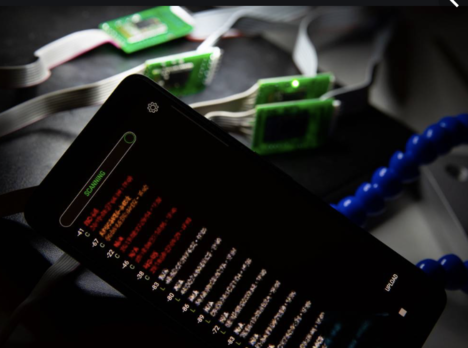
"Bluetana," a new mobile app that looks for Bluetooth-based payment card skimmers hidden inside gas pumps, is helping police and state employees more rapidly and accurately locate compromised fuel stations across the nation, reported Krebs on Security.
The new app, now being used by agencies in several states, is the brainchild of computer scientists from the University of California San Diego and the University of Illinois Urbana-Champaign, who say they developed the software in tandem with technical input from the U.S. Secret Service—the federal agency most commonly called in to investigate pump skimming rings, Krebs said.
“Gas pumps are a perennial target of skimmer thieves for several reasons. They are usually unattended, and in too many cases a handful of master keys will open a great many pumps at a variety of filling stations,” Krebs on Security said.
The skimming devices can then be attached to electronics inside the pumps in a matter of seconds, and because they’re also wired to the pump’s internal power supply the skimmers can operate indefinitely without the need of short-lived batteries.
Leveraging Bluetooth
And increasingly, these pump skimmers are fashioned to relay stolen card data and PINs via Bluetooth wireless technology, meaning the thieves who install them can periodically download stolen card data just by pulling up to a compromised pump and remotely connecting to it from a Bluetooth-enabled mobile device or laptop, Krebs said.
According to the universities study, some 44 volunteers — mostly law enforcement officials and state employees — were equipped with Bluetana over a year-long experiment to test the effectiveness of the scanning app.
The researchers said their volunteers collected Bluetooth scans at 1,185 gas stations across six states, and that Bluetana detected a total of 64 skimmers across four of those states. All of the skimmers were later collected by law enforcement, including two that were reportedly missed in manual safety inspections of the pumps six months earlier, Krebs on Security said.