

MADISON, Wis.–A survey conducted by the World Council of Credit Unions (WOCCU) offers an update on where its member credit unions around the world stand on the digital transformation curve.
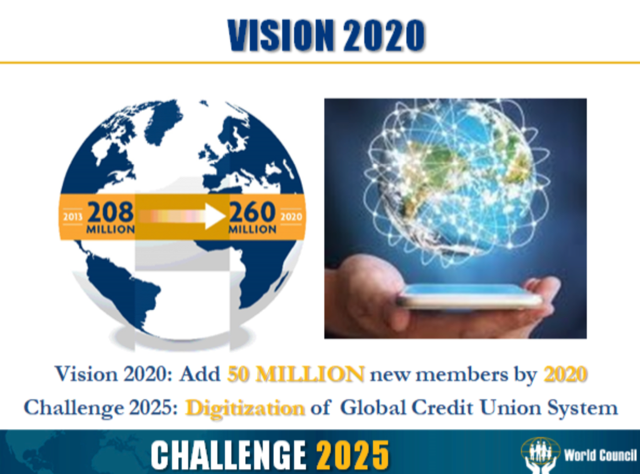
In support of WOCCU’s “Challenge 2025” initiative, WOCCU said it completed a survey of its national association members on the status of digital offerings in their respective countries. The organization noted the basic level of credit union digital transformation is to offer core services via digital online and mobile channels.
“Previously, this was a matter of consumer convenience and competitiveness,” WOCCU stated. “Consumers do their social networking, get their news, make payments and do their commerce now via online and mobile channels. It is only natural that they expect to do their finance via digital channels as well.”
Among the findings:
Online and Mobile Channels
Of those member organizations who responded, WOCCU found online banking channels are offered in:
- 100% of credit unions in Brazil and Guatemala
- 84% in Poland
- 71% in the Dominican Republic
- 70% in Kenya
- 30% in Estonia
- 10% in Cameroon
According to WOCCU, online loan processing and approval has proven to be a major membership growth onloading ramp for credit unions. Online loan processing is available via national associations in Brazil, Guatemala, Poland and Kenya.
Mobile phone transactions are integrated into the online banking channel for credit unions in Brazil, Guatemala, Dominican Republic, Poland, Estonia, Nepal, Kenya and Cameroon.
Mobile Banking Channels
When it comes to mobile banking channels, WOCCU found the solutions are offered in:
- 100% of credit unions in Brazil and Guatemala
- 84% in Poland
- 70% in Kenya
- 35% in Dominican Republic
- 30% in Estonia
- 15% in Cameroon
- 12% in Malawi
- 8% in Nepal
Mobile deposit services are available in Brazil, Guatemala, Poland, Estonia, Nepal, Kenya and Malawi, while mobile loan processing and approval is available in Brazil, Poland, Estonia and Kenya, WOCCU said.
About Safety
“In the COVID-19 world, it is no longer a just matter of convenience but rather an urgent consumer imperative for safety,” reported WOCCU. “In the post COVID-19 arrival, the definition of “most friendly service” changes from the previous definition of personal treatment to digital ease. Consumers look for digital channels that are simple, easy to use, require fewer clicks (steps), and work consistently without errors and dead ends.”
WOCCU said that for many credit union systems made up of small credit unions, shared platforms provide a vehicle for small credit unions to access digital technology.
Data Processing Systems
WOCCU noted sustainability and digital transformation require a foundation of efficient data processing.
“The expense of digitization challenges individual or small credit union systems—but credit unions have the advantage of being able to pool their resources and cooperate in building shared platforms to provide consolidated back-office processing and payment channels,” the organization said.
Of the associations that responded to its survey, WOCCU found:
- Brazil (Sicredi), Guatemala (FENACOAC), Poland (NACSCU), Dominican Republic (AIRAC), Cameroon (CamCCUL), Kenya (KUSCCO), Malawi (MUSCCO), Nepal (NEFSCUN) and Estonia (EUCC) offer a common back-office data processing system for credit unions.
- The Korea (NACUFOK), El Salvador (FEDECACES) and Philippines’ associations (NATCCO and PFCCO) offer common data processing platforms for credit unions.
- Of these, affiliated credit union usage ranges from a high of 100% in Brazil and Guatemala to:
- 99% in Cameroon
- 96% in Poland
- 83% in Dominican Republic
- 75% in Malawi
- 15% in Nepal
- 14% in Estonia
- 2% in Kenya
In most other countries, credit unions use stand-alone commercial data processing packages, WOCCU said.
Shared Payments Platforms
Associations that offer shared payments platforms that allow credit unions to provide online and mobile payment services include:
- Brazil (Sicredi), Guatemala (FENACOAC), Poland (NACSCU), Dominican Republic (AIRAC), Cameroon (CamCCUL), Kenya (KUSCCO), Malawi (MUSCCO), Nepal (NEFSCUN) and Estonia (EUCC).
“We also know that the Korea (NACUFOK) and the Philippines' associations (NATCCO and PFCCO) offer shared payments platforms for credit unions. Australia has one of the most advanced shared payment platforms in the New Payments Platform (NPP), owned by and serving both cooperative and commercial banks, as well as credit unions,” WOCCU said.
World Council reported credit union usage of these platforms shows more variability, from:100% in Brazil and Guatemala to:
- 84% in Poland
- 53% in the Dominican Republic
- 35% in Cameroon
- 30% in Estonia
- 13% in Malawi
“The shared platforms are linked to the national payments systems in Australia, Brazil, Estonia, Kenya and Malawi. We also know that the Philippines (NATCCO and PFCCO) is making gains in negotiating linkage of their shared payments platform to the national payments,” WOCCU said. “Several countries have found it is not efficient or affordable to create their own digital systems, but choose rather to build shared platforms and establish strategic alliances to aggregate credit unions to connect to digital systems and their country’s digital ecosystem.”