

WASHINGTON–Credit union leaders gathered here to “stand up” and offer some unvarnished opinions and views on a variety of issues, ranging from whether the tax exemption is still merited, if the CU business model is still relevant, and even what many credit unions get wrong in their annual planning sessions.
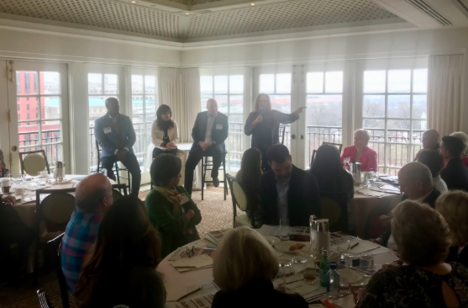
The comments came during the “Underground Collision” meeting that is hosted by Mitchell Stankovic & Associates. This year’s even was themed “Stand Up!” and, as it is every year, was designed to be about a “collision of ideas, challenges, and opportunities for credit unions. The event was held atop the Hay Adams Hotel in Washington, across from the White House, and in advance of CUNA’s GAC.
Among some of the observations and insights shared:
During a session titled “Speed Up!,” which focused on taking risks and quickening the decision cycle, as well as reexamining service to the underserved:
- Jennifer Oliver, president/CEO of South Bay Credit Union in Redondo Beach, Calif.: “You have to be willing to experiment to get out of the sea of sameness. You have to be willing to fail forward faster.” Oliver pointed to South Bay’s “pop-up branches” and its video chat functionality as areas where it has experimented (and succeeded).
- Shazia Manus, chief strategy and business development officer with AdvantEdge Analytics: “There is no right recipe for success. It’s about knowing when to pivot. From a macro-reality standpoint, there are three key realities: One, digital transformation has emboldened the consumer, so it becomes about how to stay relevant. We talk about people helping people; that has been the roots of credit unions. Now, it’s about how to modernize the mission by knowing the members better. That was easy to do when you were face to face. It’s not so easy through the other channels, which creates silos. The question is, who are you here to serve? The little man (under the umbrella) is still relevant, but now it’s also the little gal as well as a person of color.
Two, technology shrinks barriers to entry, with open architecture and APIs. Who are you partnering with? What is their strategy?
Three, with digital transformation, when should you interrupt? You should do it when you’re at your peak and when things are going well.
- Cliff Rosenthal, principal, Archer + Rosenthal (and the former head of the National Federation of CDCUs who later went to work at the CFPB). “History is subversive, it informs the present. The mission is more than an app.” Rosenthal encouraged credit unions to continue to invest in the concept of democracy with members.
During a session titled “Break Up!,” which examined which is the business model that best fits the credit union cooperative model, including the idea of breaking up credit unions:
- Lucy Ito, president/CEO of NASCUS: “The credit union movement is still tiny when compared to banks; credit unions have about $1.5 trillion in assets, and banks have more than $18 trillion. So breaking up credit unions would mean losing our collective scale. My fantasy is to have every single credit union participating in shared branching and shared ATMs. And we should remember there was a time when people said if we offered share drafts we would no longer be credit unions.”
In response to a question on whether the shoe fits, should credit unions lose the tax exemption, Ito responded, “The shoe doesn’t fit. Why should credit unions apologize to the banking system? Why should we let banks define who we are? To serve people of modest means requires you to have a viable business model.”
- Scott McFarland, CEO, Honor Credit Union, Berrien Springs, Mich.: “Too often, we define ourselves by asset size. Banks do that because that’s how they are. Our challenge in Washington is not to show up here and act and look like banks. The one thing we always hear from speakers at GAC is keep doing what you’re doing and show us what you’re doing.”
On taxation: “Personally, I don’t want to give even more money to people who can’t balance their own checkbook.”
- Dwayne Naylor, president, Civic FCU (a start-up CU in North Carolina that was just granted its charter in November 2018): “It’s not the charter that’s holding us back. We sometimes look to the bank charter and think it’s better over there. But we have to look back to the vision of our grandparents and why they started a credit union.”
During a session called “Live Up!,” which examined billion-dollar CUs, CUSOs and competition from Google, Apple, Facebook, Amazon, and smaller fintechs, as well as leadership:
- Kevin Martin, SVP—organizational performance and strategic planning at SchoolsFirst FCU in Santa Ana, Calif. “When it comes to the member journey, we must start with the member and end with the member. Do you start your planning sessions talking about the competition or new solutions? I humbly suggest you stop doing that. You start with understanding the members’ needs and challenges and aspirations. It’s not just a financial discussion. How do they choose their healthcare? How do they get their kids to school? What you have as credit unions is what everyone else wants: the trust of your members, and that cannot be matched by Google or Apple. This is unique to everyone in this room.”
- Sarah Canepa-Bang, consultant, formerly of CO-OP: “Americans have never needed credit unions more than they need them now. Fintechs may remove friction, but the problem is 50% to 75%of Americans are living paycheck to paycheck. It’s not just poor people. A fintech’s motivation is different than ours and we need to remember that when we partner with them. We can compete with them, but we have to do it with our own DNA, not theirs, and that is cooperation. (Google, Amazon, Facebook, Apple) is a different beast; they’ve got enough money and what that money allows them to do is figure out how to cooperate. Cooperation has always been good business.
“I hesitate to say this, but cooperation appears to be fading. You should be using your CUSOs; it’s good business. Cooperation is a deliberate act. You have to know you’re cooperating to cooperate.”
Mike Valentine, CEO, BCU, Chicago: “What people share is passion. It’s all about what does the member want and when do they want it. We have relationships with our members, and every business wants that. There are still Fortune 20 companies that don’t have a credit union and want one.
“My big fear is around how we have to deliver this experience over a device. That is what leadership is about. We now need to be more inclusive and have more diversity of thought. We say we want people to challenge us, but do we really?”