

WASHINGTON–Nonrecurring events at three large FDIC-insured banks contributed to the industry reporting a 7.3% decline in net income during the third quarter when compared to the same period one year earlier, according to the agency.
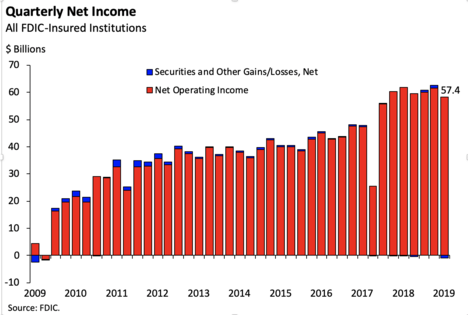
However, 62% of all institutions reported a year-over-year increase in net income; slightly more than 4% of institutions were unprofitable.
Net income at community banks was up during the third quarter, the FDIC data show.
Overall, the FDIC said aggregate net income totaled $57.4 billion during Q3, a decline of $4.5 billion from a year ago. The decline in net income was caused by higher noninterest expense and loan-loss provisions and realized securities losses.
The data includes 5,256 commercial banks and savings institutions insured by the FDIC and is included in the agency’s latest Quarterly Banking Profile.
‘Positive Results’
“The banking industry reported positive results this quarter, despite nonrecurring events at three large institutions that affected quarterly net income,” FDIC Chairman Jelena McWilliams said in a statement. “Overall, the banking industry reported strong loan growth, and the number of ‘problem banks’ remained low. Community banks also reported another positive quarter. Net income at community banks improved due to higher net operating revenue, and the annual rate of loan growth at community banks exceeded the overall industry.
“This quarter, we also saw two reductions in short-term interest rates and a flat yield curve, which present new challenges in credit extension and funding,” McWilliams continued. “It is imperative that banks maintain careful underwriting standards and prudent risk management in order to maintain lending through this economic fluctuation.”
The Specifics
Among the specific data points included in the 2019 Quarterly Banking Profile:
- ROA Declines. The average return on assets declined from 1.41% in third quarter 2018 to 1.25%
- But Not at Community Banks. The 4,825 FDIC-insured community banks reported net income of $6.9 billion in third quarter 2019 (up 7.2%), or up $466 million from a year ago. Pretax return on assets rose three basis points to 1.51%, marking the highest quarterly pretax return on assets reported by community banks since third quarter 2006, the FDIC said.
- Revenue Growth Drivers. Growth in net interest income (up 4% to $19 billion), noninterest income (up 16.4% to $5.1 billion), and gains on securities sales (up 675.1% to $164.5 million) were responsible for the annual increase in profitability. Revenue growth in these areas offset increases in noninterest expense (up 5.8% to $15.2 billion), provision expense (up 24.9% to $754 million), and income tax expense (up 12% to $1.4 billion), according to the agency.
- Net Interest Income Up. Net interest income increased by $1.7 billion (1.2%) from 12 months ago, making it the lowest annual growth rate since fourth quarter 2014. Lower yield on earning assets contributed to the slowdown in net interest income. “However, slightly more than two-thirds of all banks (70.9%) reported annual increases in net interest income,” the FDIC said. “The average net interest margin declined by 10 basis points from a year ago to 3.35%.”
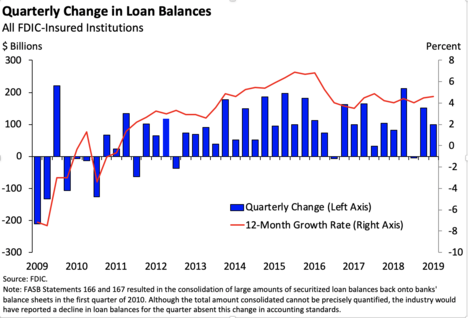
- Loan/Lease Balances Up. Total loan and lease balances increased by $99.5 billion (1%) from the previous quarter. Growth among major loan categories was led by consumer loans, which includes credit cards (up $31.3 billion, or 1.8%) and residential mortgage loans (up $22 billion, or 1%). Over the past year, total loan and lease balances rose by 4.6%, slightly above the 4.5% annual growth rate reported last quarter. Commercial and industrial loans registered the largest dollar increase from a year ago (up $131.9 billion, or 6.3%).
- Asset Quality Indicators Remained Stable: The amount of loans that were noncurrent (i.e., 90 days or more past due or in nonaccrual status) declined by $184.8 million (0.2%) from the previous quarter. Noncurrent balances reported mixed results for major loan categories. Residential mortgages declined by $407.4 million (1%), while credit card balances rose by $940.9 million (8.1%) and commercial and industrial loans increased by $263.5 million (1.5%).
- Noncurrent Loan Rate Declines. The average noncurrent loan rate declined by one basis point from the previous quarter to 0.92%. Net charge-offs rose by $1.9 billion (17.2%) from a year ago, and the average net charge-off rate rose to 0.51%, the FDIC reported.
- Problem Bank List Shrinks. The number of problem banks fell from 56 to 55 during the third quarter, the lowest number of problem banks since first quarter 2007. Total assets of problem banks rose modestly from $48.5 billion in the second quarter to $48.8 billion.
- The Deposit Insurance Fund’s Reserve Ratio Rose to 1.41%: The Deposit Insurance Fund (DIF) balance totaled $108.9 billion in the third quarter, an increase of $1.5 billion from the previous quarter. The quarterly increase was due to assessment income, interest earned on investment securities held by the DIF, and a reduction in losses from past failures. The reserve ratio rose by 1 basis point from the previous quarter to 1.41%.
- Mergers and New Bank Openings Continued in the Third Quarter: During the third quarter, four new banks opened, 46 institutions were absorbed by mergers, and no banks failed, the FDIC said.