

ALEXANDRIA, Va.––At the end of Q1, credit union loans outstanding had increased 10.7% over the same time one year earlier, according to data released by NCUA.
Meanwhile, credit unions added 13 million members over the past five years, according to NCUA.
“The credit union system again experienced solid performance during the first quarter of 2016,” NCUA Board Chairman Rick Metsger said in a statement. “Overall, new and used auto lending was especially strong, and the system gained one-million members. With an influx of deposits, federally insured shares at credit unions also neared the $1-trillion mark coming in at $991.7 billion.
“As credit union lending has increased, long-term investments have declined and reduced the system’s interest rate risk,” Metsger continued. “However, delinquency and charge-off rates are slightly higher than a year ago, and member-business loan delinquencies are rising even more. Credit unions making such loans should take note and ensure that they perform proper due diligence to mitigate the risk.”
Here’s a look at the numbers as drawn from 5300 Call Reports at March 31, 2016, according to NCUA:
Total loans at federally insured credit unions reached $799.5 billion at the end of the first quarter, an increase of 10.7% from one year earlier.
Year over year, loans grew in every major category, including:
- New auto loans jumped 15.4% to $103.0 billion.
- Used auto loans rose 13.2% to $166.8 billion.
- Total first-mortgage loans outstanding grew 10.4% to $327.9 billion.
- Other real estate loans grew by 3.9% to $74.3 billion.
- Net member-business loan balances increased 13% to $59.8 billion.
- Non-federally guaranteed student loans expanded 10.9% to $3.6 billion.
- Payday alternative loans originated at federal credit unions rose 8.1% to $106.1 million at an annual rate.
NCUA said the loans-to-shares ratio on March 31 was 76.1%, up 2.7 percentage points from a year earlier. The ratio, however, fell for the quarter due to an influx of member deposits.
Long-Term Investments Continue to Decline
Total investments, defined as investments greater than three months, by federally insured credit unions stood at $272.4 billion at the end of the first quarter, down 2.8% over the last year. Investments with maturities greater than 10 years remained unchanged from the previous quarter at $4.5 billion, though they were down 14.9% from the first quarter of 2015.
Investments with maturities of one to three years were $103.5 billion in the first quarter. Overall, these investments have declined 3.3% during the last year. The system’s ratio of net long-term assets to total assets came in at 31.7%, down 0.8 percentage point from a year ago and the lowest level since the third quarter of 2010, NCUA said.
Overall Delinquency and Charge-Off Rates Rise Slightly
The delinquency rate at federally insured credit unions was 71 basis points in the first quarter, up two basis points from a year earlier. The delinquency rate for fixed real estate was down for the last four quarters, but the delinquency rates for credit cards and member business loans rose with member business loan delinquencies rising faster, coming in at 141 basis points on March 31.
The system’s net charge-off ratio increased slightly to an annualized 52 basis points in the first quarter, up from 47 basis points at the end of the first quarter of 2015, according to NCUA.
Asset and Deposit Increases Continue
Total assets in federally insured credit unions rose to more than $1.2 trillion at the end of March, an increase of 7.1% for the year ending in the first quarter. Deposits at federally insured credit unions increased 6.8% during the same period to nearly $1.1 trillion.
Credit Unions Remain Well Capitalized
According to the agency, the percentage of federally insured credit unions that were well capitalized remained steady in the first quarter with 97.8% reporting a net worth ratio at or above the statutorily required 7%. At end of first quarter of 2016, 0.7% of federally insured credit unions were less than adequately capitalized.
Overall, the credit union system’s aggregate net worth ratio was 10.78% at the end of the first quarter, down three basis points from a year earlier.
Membership Nears 104 Million, Even as Consolidation Continues
Membership in federally insured credit unions grew to 103.7 million in the first quarter of 2016, an increase of 3.8% from the first quarter of 2015. In all, credit unions have added one-million members during the quarter and 13-million members during the last five years.
Continuing a long-standing trend, the number of federally insured credit unions fell to 5,954 at the end of the first quarter of 2016, 252 less than a year ago, NCUA said. The decline occurred primarily in the number of credit unions under $10 million in assets. Overall, there were 3,721 federal credit unions and 2,233 federally insured, state-chartered credit unions.
Credit Unions’ Net Income Increases; Return on Average Assets Ratio Steady
Federally insured credit unions reported net income of $9.2 billion on an annualized rate in the first quarter of 2016, up 3.5% from the $8.9 billion reported in the first quarter a year ago.
The annualized return on average assets ratio for federally insured credit unions stood at 75 basis points the first quarter in 2016, down three basis points from a year earlier.
Larger Credit Unions Again Lead the System in Performance
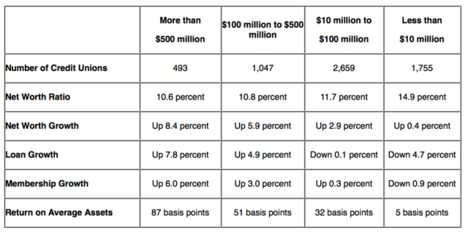
Federally insured credit unions with more than $500 million in assets led the system in most performance measures in the first quarter of 2016, continuing a long-standing trend.
With $902.5 billion in combined assets, these 493 credit unions—up from 481 at the end of 2015—held 72.7% of total system assets. The 4,414 credit unions with less than $100 million in assets held 8.6% of the system’s total assets.
As in previous quarters, large credit unions again reported the fastest growth in loans, membership and net worth, as well as the highest return on average assets. Credit unions with assets of less than $10 million, as a whole, experienced declines in loans and membership. Credit unions with assets between $10 and $100 had positive net worth and membership growth, but experienced a slight decline in loan growth.